

Meet ALICE: Shining a Light on Financial Hardship in Colorado
ALICE (Asset Limited, Income Constrained, Employed)
We all know ALICE — your local grocery store cashier, food service worker, janitor, waiter or waitress, personal care aide, child care provider, etc. — those who sustain the foundation of our daily lives. ALICE is your neighbor, your friend; some of us have been ALICE, and some of us are ALICE now.
Yet ALICE is a largely hidden population: Because ALICE households often do not qualify for aid or social programs, they remain invisible to the system. ALICE households earn above the Federal Poverty Level, yet not enough to afford the basic necessities, despite working full-time or at multiple jobs. Forced to make impossible decisions each month, like choosing between child care or paying rent, ALICE households are often one emergency from slipping further into financial instability. The way ALICE households currently navigate these obstacles will not be good enough going forward — we must do better. By raising awareness of the challenges ALICE households face, our collective work to help build financial stability for ALICE households has a better chance of succeeding.
- ALICE: Asset Limited, Income Constrained, Employed – households with income above the Federal Poverty Level (FPL) but less than the basic cost of living in their county.
- ALICE Household & Survival Budget: Reflects the minimum costs of household necessities (housing, child care, food, transportation, health care, and technology) plus taxes, adjusted for all U.S. countries and various household compositions.
- ALICE Threshold: Derived from the Household Survival Budget, the minimum average income that a household needs to afford basic costs, calculated for all U.S. counties.
- Below ALICE Threshold: Includes households in poverty and ALICE households combined

Dive deeper into the data with the comprehensive report!
Note – this will open in a separate pdf. If you are unable to view or read it, please contact us for assistance.
ALICE IN COLORADO
Over the last decade, the number of ALICE households in Colorado has been on the rise as wages have failed to keep up with inflation and the rising cost of household basics. ALICE households struggle to afford basic necessities — housing, child care, food, transportation, health care, and technology. Public assistance has filled in some of the gaps, especially during the pandemic, but it has never been enough to bring all families to financial stability.
This consistent trend — a growing number of households that are struggling financially, undercounted by official measures, and largely ineligible for public assistance— represents a major vulnerability in our economic system. It also suggests that overall social and economic policies are falling short in addressing the root causes of financial instability.
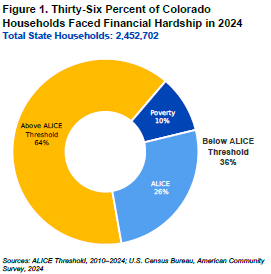
Of Colorado’s 2,452,702 households…
- 10% (236,293) were below the FPL, and another 26% (640,791) were ALICE — households with income above the FPL, but not enough to afford the ALICE Household Survival Budget for their household composition and location
- Combining these two groups, 36% (877,084) of households were below the ALICE Threshold
- Despite some ups and downs, the number of ALICE households in Colorado trended upward overall between 2010 and 2024 while the number of households in poverty held relatively steady
- More recently (between 2021 and 2024), the number of ALICE households declined slightly while the number in poverty increased slightly.
WHO IS BEHIND ALICE?
United For ALICE is a research-driven organization focused on improving life for those who are Asset Limited, Income Constrained, Employed (ALICE®). By uncovering the realities of financial hardship, ALICE drives innovative solutions at the local, state, and national levels.
Together, we can create a brighter future for every family in Colorado.
Get Support
If you or someone you know in Routt, Moffat, or Rio Blanco Counties needs support, United Way of the Yampa Valley is here to help.
From housing assistance and food security to mental health services and childcare resources, we connect individuals and families with vital programs that strengthen our community. Whether you’re facing financial hardship, seeking healthcare, or looking for educational opportunities, local resources are available to provide guidance and relief.